- "Tight hips" is four muscle groups: hip flexors at the front, gluteals at the back and side, the deep rotators (including piriformis) under them, and the adductors on the inner thigh [1][2][3]. A chair shortens the first and switches off the second.
- Sitting is linked with stiff hip flexors: adults who sit more than 7 hours a day and move little have about 6 degrees less passive hip extension than active people who sit less [4]. The evidence that this tilts the pelvis and causes back pain is far weaker than the internet suggests [7][8][10].
- Stretching the hip flexors does something measurable: in a year-long trial of 563 office workers, a 30-second iliopsoas stretch twice a workday plus two short trunk sessions a week more than halved new episodes of low back pain [11].
- Hip pain after sitting has a geography: front and groin usually means the flexors, the outside of the hip the gluteal tendons (worse with crossed legs), and buttock pain that builds the longer you sit points to piriformis or the back [16][17][15].
- The four original exercises stay (Inside Thigh Stretch, Butterfly Pose, gentle King Pigeon, Spinal Twist) and two join them: a hip-flexor lunge done without arching the back, and the 90/90. Dose: about 60 seconds per muscle group, two to three days a week, to mild tightness and never pinching [21][22].
What actually sits in your hip
Hips are designed to move in nearly every direction, and then we put them in a chair for eight hours, where they move in none. If squatting feels creaky, sitting cross-legged is a distant memory, or your hips simply feel locked when you stand up, it helps to know which muscle is complaining, because they do not all want the same fix.
The hip flexors
The main hip flexor, iliopsoas, is two muscles sharing one tendon: psoas major starts on the lumbar vertebrae, iliacus inside the pelvic bowl, and together they attach to the lesser trochanter on the inner thigh bone [1]. Their job is to lift the thigh, which is exactly the position a chair holds them in, and because psoas is anchored to the lower back, a short, tense psoas pulls on the lumbar spine as well as the thigh. Rectus femoris, the middle quadriceps muscle, also crosses the hip [1]; it is the one you feel down the front of the thigh in a deep lunge.
The gluteals
Gluteus maximus is the muscle you sit on, the main extensor of the hip, recruited mainly when force is needed [2]. Gluteus medius and minimus sit on the side of the pelvis and hold it level every time you stand on one leg, which is every step [2]. Sitting asks nothing of any of them, which is why "tight hips" so often come with "weak glutes".
The deep rotators, including piriformis
Under the gluteals a row of small muscles turns the thigh outwards. Piriformis runs from the front of the sacrum to the top of the thigh bone, and the sciatic nerve emerges directly beneath it [2], which is why it gets blamed for buttock pain running down the leg. How often that is true comes later.
The adductors
The inner thigh is five muscles, most starting on the pubic bone, whose shared job is to pull the thigh inwards [3]. A chair holds the thighs parallel, so the adductors are never asked for width, and width is the first thing a squat, a cross-legged sit or a butterfly needs.
Hold any joint in one position long enough and the tissues adapt: the hip flexors get used to short, the inner thighs forget about width, the deep rotators forget about rotation. Then you ask those hips for a squat, a cross-legged sit or a long stride, and they respond like an office worker asked to sprint: technically capable, deeply unenthusiastic.
Sitting and the psoas: the myth and the evidence
The popular story: sitting shortens the psoas, the short psoas tilts the pelvis forward, the tilted pelvis arches the lower back, and the arch causes back pain. Each link has a different amount of evidence behind it.
Sitting and stiff hip flexors: supported. A 2021 University of Salford study measured passive hip extension with the modified Thomas test in 98 adults sorted by how much they sat and moved. Those who sat more than 7 hours a day and did less than 150 minutes of activity a week had 6.1 degrees less hip extension than active people who sat under 4 hours [4]. It is a snapshot, so it cannot prove the chair did it, but the authors call it the first study to show the association [4]. A small study of 46 desk workers found the shorter the iliopsoas, the deeper the lumbar curve [5], and an older experiment found hip-flexor length was the only factor explaining how much the lumbar curve changed between standing and sitting [6].
Tight flexors, tilted pelvis, back pain: not supported. Here the chain breaks. Among 120 healthy, pain-free young adults, 85% of men and 75% of women had an anterior pelvic tilt [7]; a forward-tilted pelvis is what most pain-free pelvises look like. A systematic review of 43 studies found no difference in standing pelvic tilt or lumbar curve between people with and without low back pain [8]; if anything, people with back pain tend to have a flatter lower back [9]. And a 2020 systematic review of treatments for "excessive" anterior tilt found two small randomised trials and two non-randomised ones, rated the evidence very low quality, and found no overall evidence that reducing the tilt reduces symptoms [10].
So, honestly: if you sit all day your hip flexors are probably stiffer than they would otherwise be. Whether that causes your back pain is unproven, and chasing a "neutral pelvis" in the mirror is not a good use of your time. The next finding is.
Stretching the hip flexors prevents back pain in sitters: supported. In a cluster-randomised trial, 563 office workers with below-average trunk flexibility or endurance were followed for 12 months. The exercise group did one stretch designed for the shortened iliopsoas, held 30 seconds, twice each workday at 10 a.m. and 2 p.m., plus twice-weekly endurance exercises for the back and deep trunk at home. New episodes of low back pain fell from 19.7% in the control group to 8.8%, a hazard ratio of 0.37 [11]. No yoga, no half an hour, no equipment. Two smaller pieces fit the same picture: in 96 healthy older adults, 10 weeks of home hip-flexor stretching twice a day modestly increased hip extension [12], and a 2021 meta-analysis found hip-flexor stretching of up to 120 seconds does not blunt sports performance [13].
Anterior pelvic tilt, in plain words
Stand side-on to a mirror. Your pelvis is a bowl. If the front rim dips lower than the back rim, that is anterior tilt: the lower back arches a little and the belly pushes forward. If the back rim dips, that is posterior tilt. Most people stand with a mild anterior tilt, and that is normal [7]. The argument that sitting exaggerates it is reasonable: a short psoas pulls the front of the pelvis down and idle glutes do not balance it. The argument that this is a disease, sometimes sold as "lower crossed syndrome", runs ahead of the data: pain-free people have the tilt [7], people with back pain do not have more of it [8], and correcting it has not been shown to help [10]. Treat the tilt as a description of how you stand, not a diagnosis. Then stretch the front and strengthen the back, because both make the hip move better, which you can measure.
Hip pain after sitting: what it usually is
Stiffness when you stand up, easing after a few steps, is the ordinary cost of a long sit. Pain is different, and where it sits tells most of the story.
Front of the hip or groin
A pulling, tight feeling at the hip crease, worse when you stand tall after sitting, is usually the flexors. A true hip-flexor strain typically follows a sprint, a kick or a sudden effort, brings pain, tightness and sometimes a limp, and usually heals in a few weeks with rest and ice [14]. A deep groin ache that is worse with walking, with morning stiffness that takes a while to wear off, is more likely the joint: the NHS lists osteoarthritis as a common cause of hip pain over 45 and advises seeing a GP if morning stiffness lasts longer than 30 minutes or the pain has not improved after two weeks of self-care [15].
Outside of the hip
Pain over the bony point on the side of the hip, worse lying on that side at night, standing on one leg, or after sitting with crossed legs, is most often gluteal tendinopathy, now regarded as the main local cause of lateral hip pain. It is most common in mid-life, more in women, and the key aggravating factor is excessive hip adduction: positions that bring the thigh across the midline and squash the tendons against the bone [16]. The fix is less compression and stronger glutes, not a harder stretch; an aggressive stretch across the body is exactly the compression these tendons dislike [16].
Buttock pain that gets worse the longer you sit
Deep buttock pain, tenderness near the sitting bone, pain that builds with sitting and sometimes runs down the back of the thigh: this is the pattern of piriformis syndrome. A systematic review found four features define it: buttock pain, pain aggravated by sitting, tenderness near the greater sciatic notch, and pain on any manoeuvre that tenses the piriformis [17]. How common it is remains uncertain: some reviews suggest 5% to 8% of low back pain cases [18], others argue it is over-diagnosed [19]. No treatment has been shown to beat another, and the review that looked hardest concluded first-line care should follow the general back pain and sciatica guidelines: physiotherapy and movement [20]. The same pattern can come from the spine; if pain shoots below the knee or comes with numbness or weakness, read the sciatica guide and get the back checked first.
In the car, on the floor, cross-legged
A car seat flexes the hip past 90 degrees for hours; the floor does the same, and cross-legged sitting adds outward rotation stiff hips do not have. None is dangerous, but each is a long static hold at the end of a range you have not been using. The NHS self-care list says it well: stay active without overdoing it, avoid low chairs, try gentle hip stretches [15].
A two-minute self-test
- Thomas test, home version. Sit on the very edge of a bed, roll back to lying, hug one knee to your chest and let the other leg hang. If the hanging thigh rests level with the bed, your hip flexors are fine. If it floats above the bed, iliopsoas is short; if the thigh lies flat but the knee wants to straighten, rectus femoris is the tighter one. This is the test the sitting studies used [4][5].
- 90/90 check. Sit on the floor with the front shin across in front of you and the back shin out to the side, both knees at a right angle. If you cannot sit upright without a hand behind you, rotation is the limit.
- Butterfly height. Soles together, sit tall, note how far the knees are from the floor in centimetres.
Write the results down. The honest timeline: looser within the first week, measurable change in four to eight weeks of near-daily work; the older-adult trial took 10 weeks to show a modest change [12]. Hips reward patience more than force.
The stretches, with hold times
The dose first. The American College of Sports Medicine recommends flexibility exercises for each major muscle-tendon group totalling about 60 seconds per exercise, on at least two days a week [21]; Harvard Health summarises the same panel as two to three sessions a week, the 60 seconds split any way you like, say 15 seconds four times [22]. Stretch to mild tension, never to pinching in the groin, and breathe: ten slow breaths is a better clock than counting.
| Exercise | Targets | Hold | Reps | Best for |
|---|---|---|---|---|
| Inside Thigh Stretch | Adductors (inner thighs) | 20–30 s per side | 2 | Width the chair deleted |
| Butterfly Pose | Adductors, hip rotators | 30–45 s | 2 | Cross-legged comfort |
| King Pigeon Pose (gentle) | Hip flexors, rectus femoris | 20–30 s per side | 2 | Front of hip shortened by sitting |
| Spinal Twist | Mid-back, hip stability | 3–5 breaths per side | 1–2 | Rotation; finishing the set |
| Hip-flexor lunge, done right | Iliopsoas | 30 s per side | 2 | At work, twice a day, no equipment |
| 90/90 | Gluteals, piriformis, deep rotators | 30 s per side | 2 | Buttock stiffness, floor sitting |
1. Inside Thigh Stretch
How to do it with FlexBuddy:
- Sit tall and extend one leg out to the side, hooking FlexBuddy around that foot.
- Hold the handles and use light tension to keep your chest lifted.
- Lean gently toward the extended leg until the inner thigh responds.
- Hold 20–30 seconds per side, breathing slowly.
What you should feel: a clear, kind stretch along the inner thigh, with no pinching in the groin.
Why it helps: the inner thighs are the first thing a chair narrows and the first thing a squat needs. The handle support means you stretch them without fighting to stay upright.
Beginner tip: small lean, tall chest. Collapsing forward feels deeper but stretches less.
2. Butterfly Pose
How to do it with FlexBuddy:
- Sit with the soles of your feet together, knees falling outward.
- Hook FlexBuddy around both feet and hold the handles.
- Use gentle handle tension to sit tall, then, if comfortable, hinge slightly forward from the hips.
- Stay 30–45 seconds, breathing slowly, letting the knees sink only as far as they want.
What you should feel: opening through the inner thighs and hips; a sense of the knees getting heavier as you breathe.
Why it helps: butterfly is the classic hip opener, but unsupported it turns into a slouch. The handles solve the real problem, staying tall, so the hips can do the opening.
Common mistake: pushing the knees down with your hands or hurrying them. Gravity plus breath is the whole technique.
3. King Pigeon Pose, the gentle FlexBuddy version
The full yoga pose is an advanced backbend. This version borrows only its most useful part for sitters, the deep front-of-hip opening, with support doing the reaching.
How to do it with FlexBuddy:
- Kneel on one knee in a low lunge, the other foot planted in front (cushion under the back knee if needed).
- Hook FlexBuddy around the back foot and bring the handles over your shoulder.
- Stay tall and gently draw the back heel toward you until the front of that hip and thigh respond.
- Hold 20–30 seconds per side, mild tension, steady breath.
What you should feel: a strong but clean stretch along the front of the back-leg hip and thigh. No lower back arching, no knee pinching.
Why it helps: this targets exactly what eight hours of sitting shortens, and because the heel comes towards you it reaches rectus femoris, the flexor that also crosses the knee [1]. The over-the-shoulder handle reach replaces the contortion the classic pose demands, the difference between an advanced posture and a beginner-usable one.
Beginner tip: tuck your pelvis slightly (zip up tight jeans) before drawing the heel in. It doubles the stretch at half the depth.
4. Spinal Twist
How to do it with FlexBuddy:
- Sit with legs extended, FlexBuddy hooked around your feet, both handles in one hand.
- Inhale to sit tall; exhale and rotate your torso to the free side, other hand on the floor behind you.
- Keep both sit bones grounded. Hold 3–5 breaths per side.
What you should feel: rotation through the mid-back with the pelvis staying square and stable.
Why it ends the routine: hips and mid-back share the rotation workload in real life, walking, reaching, turning. Finishing with the twist reconnects the freshly opened hips to the spine above them.
5. The hip-flexor lunge, done right
The stretch from the office-worker trial, and the one most people do wrong. No equipment needed.
- Kneel on one knee (cushion under it), the other foot flat in front, both knees at about a right angle.
- Before moving anywhere, tuck your tailbone under and gently tighten the buttock of the kneeling leg. Ribs down, trunk upright.
- Shift your whole body forward a few centimetres, hips first. Hold 30 seconds, breathing. Swap sides.
What you should feel: a deep pull at the crease of the kneeling hip, perhaps down the front of the thigh. Nothing in the lower back.
Why it helps: the common version, a long lunge with the chest forward and the back arched, stretches nothing, because the pelvis tips forward and lets iliopsoas off the hook. Tucked, braced, then forward is the whole trick, and 30 seconds twice a workday was enough to more than halve new back pain over a year [11]. Standing version for the office: step one foot back a stride, tuck the tailbone, squeeze the back-leg buttock and push that hip forward.
6. 90/90
- Sit on the floor, front shin across in front of you, back shin out to the side, both knees bent to about 90 degrees. Sit as tall as you can; a cushion behind you is fine.
- Hinge forward over the front shin with a long spine until the outside of the front hip and buttock respond. Hold 30 seconds.
- Sit up, lean a little towards the back leg to feel the inside of that hip, 30 seconds. Swap sides.
What you should feel: the front leg works gluteus maximus and the deep rotators including piriformis; the back leg the inside of the opposite hip. Nothing sharp, nothing running down a leg.
Why it helps: rotation is the movement a chair deletes completely. Lying on your back with one ankle crossed over the other knee (the figure-4) reaches the same tissues and is the version for bed or hard floors.
Strength matters as much as stretching
Every muscle a chair shortens has a partner it switches off: short hip flexors with an idle gluteus maximus, stiff adductors with a gluteus medius that has not held the pelvis level all day. Stretch the short side without working the idle side and you get a hip that feels looser for an hour, then returns to the only position it is strong in. The guidelines treat the two as a set: alongside flexibility work, adults should do resistance exercise for each major muscle group on two to three days a week [21], and the 2020 WHO guidelines add muscle-strengthening for all ages while recommending less sedentary time [23]. The office-worker trial was a hip-flexor stretch plus twice-weekly endurance work for the back and trunk, not stretching alone [11].
Three movements cover it without a gym: glute bridges, 2 sets of 12; side-lying leg raises or small banded side-steps for gluteus medius, 2 sets of 12 per side; and, most useful for sitters, standing up from your chair without using your hands, slowly, 10 times, every hour. That last one is also the sitting break the ACSM position stand recommends: frequent short bouts of standing and movement between periods of sitting, which benefit even people who train regularly [21].
Tight hips and your lower back
Because psoas is anchored to the lumbar spine, hip and back stiffness travel together. The summary from the evidence above: the two are linked, about nine in ten cases of back pain have no identifiable structural cause [24], and a programme built around a hip-flexor stretch reduced new back pain in people who sit for a living [11]. If the back is the bigger complaint, the guides on lower back pain from sitting and tight hamstrings and back pain take it from the spine's side, and the full desk routine covers the neck and shoulders above the hips.
When to see someone first
See a doctor or physiotherapist before you stretch if the hip pain started suddenly without a fall, the hip is hot, swollen or discoloured, you feel unwell with a temperature, you cannot put weight on the leg, or there is tingling or numbness after an injury [15]. Add the back's red flags: pain shooting below the knee, numbness or weakness in a leg, changes in bladder or bowel control, unexplained weight loss, or pain that keeps getting worse. Lateral hip pain that hurts to lie on is a tendon problem: less compression and more strength, not a harder stretch [16]. In pregnancy, the hormones that loosen the pelvis make deep hip stretches feel easier than they are; stay well inside the comfortable range.
Doing this with FlexBuddy
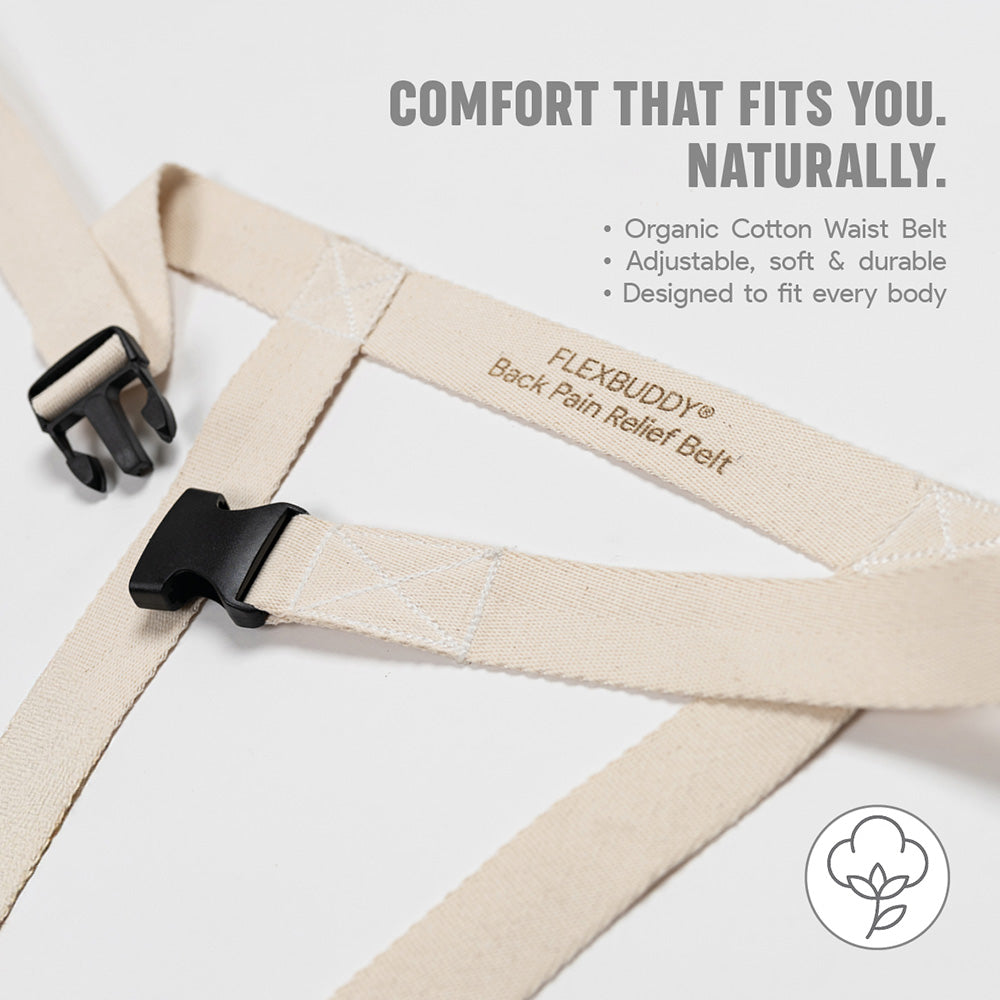
Half of this routine is seated hip work, and seated hip work has one enemy: the slouch. Reach for your feet in a butterfly or lean towards an extended leg and the lower back rounds, the pelvis rolls backwards and the stretch leaves the hips. FlexBuddy® is a stretching device made of two beech-wood bars joined by an adjustable cotton strap; one bar hooks around the feet, the other sits in your hands, and the light tension between them lets you sit tall and tilt the pelvis forward while the strap does the reaching. That is why the Inside Thigh Stretch, the Butterfly and the Spinal Twist are taught with it, the Butterfly using the strap as a loop around both feet as in the Stretching Guide. The foot bar moves between loops for big changes and the hand bar rolls the strap for small ones, so you shorten a notch a week as the knees drop. To be honest about its limits: the hip-flexor lunge and the 90/90 need no equipment, and the device will not stretch your psoas for you; it earns its place in the seated half of the routine. "Sit at a desk 9 hours a day. My lower back used to ache every evening. Two weeks in, that's basically gone," wrote one owner. Lifetime warranty, 30-day money-back guarantee. See FlexBuddy, or take the two-minute quiz; the exercise library has the rest of the seated positions.
Frequently asked questions
Can tight hips cause lower back pain?
They are linked, but cause has not been shown. Sitting goes with stiffer hip flexors [4], yet people with back pain do not have more pelvic tilt than people without it [8]. What is supported is prevention: a 30-second hip-flexor stretch twice a day plus two short trunk sessions a week halved new back pain in office workers over a year [11].
What are the symptoms of tight hips?
Stiffness at the front of the hip when you stand after sitting, a short stride, difficulty sitting cross-legged or squatting with heels down, a thigh that floats above the bed in the Thomas test, and a lower back that arches to make up for the hip in a lunge. Pain on the side of the hip or down the leg is a different problem.
Why do my hips hurt from sitting too much?
A chair holds the hip flexors short, loads the front of the joint, compresses the gluteal tendons if the knees come together, and leaves the glutes idle. Front and groin pain points to the flexors, the outside of the hip to the gluteal tendons [16], and deep buttock pain that worsens the longer you sit to piriformis or the back [17].
Is there a hip flexor stretch I can do standing at my desk?
Yes. Step one foot back a stride, tuck the tailbone, squeeze the buttock of the back leg and push that hip forward until the hip crease pulls. Thirty seconds per side, twice in the working day, is the dose from the office-worker trial [11].
Does sitting cross-legged cause hip pain?
It can aggravate pain on the outside of the hip, because crossing the legs brings the thigh across the midline and compresses the gluteal tendons against the bone [16]. If the side of your hip hurts, uncross, sit with knees level with the hips, and strengthen the glutes rather than stretching across the body.
Can I do glute stretches in bed?
Yes. Lie on your back, cross one ankle over the opposite knee and draw that knee towards you (the figure-4), 30 seconds per side; it reaches the same deep rotators as the 90/90. Hug one knee to the chest with the other leg hanging off the edge of the bed and you have the Thomas position, which stretches the hip flexors.
This article is general information, not medical advice. Tight muscles usually respond well to regular stretching. If your pain is sharp, radiates down a leg, comes with numbness, weakness, fever, bladder or bowel changes, follows an injury, or keeps getting worse, see a doctor or physiotherapist before you stretch.
References
- Jones O. Muscles of the Anterior Thigh. TeachMeAnatomy. https://teachmeanatomy.info/lower-limb/muscles/thigh/anterior-compartment/ (accessed 4 Nov 2026).
- Jones O. Muscles of the Gluteal Region. TeachMeAnatomy. https://teachmeanatomy.info/lower-limb/muscles/gluteal-region/ (accessed 4 Nov 2026).
- Jones O. Muscles of the Medial Thigh. TeachMeAnatomy. https://teachmeanatomy.info/lower-limb/muscles/thigh/medial-compartment/ (accessed 4 Nov 2026).
- Boukabache A, Preece SJ, Brookes N. Prolonged sitting and physical inactivity are associated with limited hip extension: a cross-sectional study. Musculoskelet Sci Pract. 2021;51:102282. doi:10.1016/j.msksp.2020.102282. PMID 33188982.
- Singhvi PM, Bharnuke JK. A cross-sectional study on association of iliopsoas muscle length with lumbar lordosis among desk job workers. Indian J Occup Environ Med. 2024;28(3):235–238. doi:10.4103/ijoem.ijoem_316_23. PMID 39618900.
- Link CS, Nicholson GG, Shaddeau SA, Birch R, Gossman MR. Lumbar curvature in standing and sitting in two types of chairs: relationship of hamstring and hip flexor muscle length. Phys Ther. 1990;70(10):611–618. doi:10.1093/ptj/70.10.611. PMID 2217540.
- Herrington L. Assessment of the degree of pelvic tilt within a normal asymptomatic population. Man Ther. 2011;16(6):646–648. doi:10.1016/j.math.2011.04.006. PMID 21658988.
- Laird RA, Gilbert J, Kent P, Keating JL. Comparing lumbo-pelvic kinematics in people with and without back pain: a systematic review and meta-analysis. BMC Musculoskelet Disord. 2014;15:229. doi:10.1186/1471-2474-15-229. PMID 25012528.
- Chun SW, Lim CY, Kim K, Hwang J, Chung SG. The relationships between low back pain and lumbar lordosis: a systematic review and meta-analysis. Spine J. 2017;17(8):1180–1191. doi:10.1016/j.spinee.2017.04.034. PMID 28476690.
- Falk Brekke A, Overgaard S, Hróbjartsson A, Holsgaard-Larsen A. Non-surgical interventions for excessive anterior pelvic tilt in symptomatic and non-symptomatic adults: a systematic review. EFORT Open Rev. 2020;5(1):37–45. doi:10.1302/2058-5241.5.190017. PMID 32071772.
- Sihawong R, Janwantanakul P, Jiamjarasrangsi W. A prospective, cluster-randomized controlled trial of exercise program to prevent low back pain in office workers. Eur Spine J. 2014;23(4):786–793. doi:10.1007/s00586-014-3212-3. PMC3960439.
- Kerrigan DC, Xenopoulos-Oddsson A, Sullivan MJ, Lelas JJ, Riley PO. Effect of a hip flexor-stretching program on gait in the elderly. Arch Phys Med Rehabil. 2003;84(1):1–6. doi:10.1053/apmr.2003.50056. PMID 12589613.
- Konrad A, Močnik R, Titze S, Nakamura M, Tilp M. The influence of stretching the hip flexor muscles on performance parameters: a systematic review with meta-analysis. Int J Environ Res Public Health. 2021;18(4):1936. doi:10.3390/ijerph18041936. PMID 33671271.
- Cleveland Clinic. Hip Flexor Strain. Last reviewed 3 Aug 2022. https://my.clevelandclinic.org/health/diseases/23978-hip-flexor-strain (accessed 4 Nov 2026).
- NHS. Hip pain in adults. Last reviewed 20 Nov 2025. https://www.nhs.uk/symptoms/hip-pain/ (accessed 4 Nov 2026).
- Grimaldi A, Mellor R, Hodges P, Bennell K, Wajswelner H, Vicenzino B. Gluteal tendinopathy: a review of mechanisms, assessment and management. Sports Med. 2015;45(8):1107–1119. doi:10.1007/s40279-015-0336-5. PMID 25969366.
- Hopayian K, Danielyan A. Four symptoms define the piriformis syndrome: an updated systematic review of its clinical features. Eur J Orthop Surg Traumatol. 2018;28(2):155–164. doi:10.1007/s00590-017-2031-8. PMID 28836092.
- Alrabai HM, Alrashidi Y, AlEtebi RAA, Mufti TMA, Alali MYA, Alnazhan ASA. Piriformis syndrome is often overlooked as a cause of gluteal pain and sciatica: diagnostic challenges and the role of imaging, a narrative review. HSS J. 2025. doi:10.1177/15563316251392059. PMID 41328333.
- Sharma S, Kaur H, Verma N, Adhya B. Looking beyond piriformis syndrome: is it really the piriformis? Hip Pelvis. 2023;35(1):1–5. doi:10.5371/hp.2023.35.1.1. PMID 36937215.
- Hopayian K, Mirzaei M, Shamsi M, Arab-Zozani M. A systematic review of conservative and surgical treatments for deep gluteal syndrome. J Bodyw Mov Ther. 2023;36:244–250. doi:10.1016/j.jbmt.2022.12.003. PMID 37949567.
- Garber CE, Blissmer B, Deschenes MR, et al.; American College of Sports Medicine. Position stand: quantity and quality of exercise for developing and maintaining cardiorespiratory, musculoskeletal, and neuromotor fitness in apparently healthy adults. Med Sci Sports Exerc. 2011;43(7):1334–1359. doi:10.1249/MSS.0b013e318213fefb. PMID 21694556.
- Harvard Health Publishing. The ideal stretching routine. Harvard Medical School, 16 Mar 2026 (reviewed by H. E. LeWine, MD). https://www.health.harvard.edu/staying-healthy/the-ideal-stretching-routine (accessed 4 Nov 2026).
- Bull FC, Al-Ansari SS, Biddle S, et al. World Health Organization 2020 guidelines on physical activity and sedentary behaviour. Br J Sports Med. 2020;54(24):1451–1462. doi:10.1136/bjsports-2020-102955. PMID 33239350.
- Koes BW, van Tulder MW, Thomas S. Diagnosis and treatment of low back pain. BMJ. 2006;332(7555):1430–1434. doi:10.1136/bmj.332.7555.1430. PMC1479671.