- For most adults, hold a static stretch for 10 to 30 seconds and repeat it until the muscle has had about 60 seconds in total, on at least two to three days a week, with daily being best [1][2].
- Thirty seconds is the number the trials keep landing on: holding a hamstring stretch for 60 seconds instead of 30 added nothing, and stretching three times a day did no more than once [3][4].
- The exception is age. In people over 65, 60-second holds gained range faster than 30 or 15 seconds and kept it for longer [9].
- For the first six to eight weeks a stretch mostly changes what you tolerate, not how long the muscle is. That is why regular short holds beat occasional heroic ones [12][13].
- Before sport, keep static holds short: a minute or more per muscle cuts strength and power by a few percent for a while afterwards; under 45 to 60 seconds the effect is close to nothing [6][7].
- Ten slow breaths is a better clock than a stopwatch. It lands at roughly 30 seconds and it stops you bracing.
The short answer: how long to hold a stretch, by goal
The numbers below come from the American College of Sports Medicine's position stand on exercise, which recommends flexibility exercises for each major muscle-tendon group totalling about 60 seconds per exercise on at least two days a week [1], and from the Harvard Medical School summary of the same guidance, which puts the frequency at two to three times a week and shows how the 60 seconds can be split: a 15-second hold four times, or a 20-second hold three times [2]. The trials behind each row are explained further down.
| Your goal | Hold | Repeats | How often | Notes |
|---|---|---|---|---|
| Increase flexibility | 30 seconds | 2 to 3 per muscle (60 to 90 seconds total) | 5 or more days a week | Static holds, to mild tension. Six weeks before you measure [3][4][5]. |
| Warm-up before sport | Under 30 seconds per muscle, or none | 1 | Each session | Prefer dynamic movements; if you hold, keep it short and move afterwards [6][7]. |
| After a workout | 10 to 30 seconds | 2 to 4 | After each session | Good for range and for winding down; it will not prevent next-day soreness [8]. |
| Beginners | 15 to 20 seconds, building to 30 | 2 to 3 | Daily if you can | Stop at the first clear pull. Form before duration. |
| Over 65 | 30 to 60 seconds | 1 to 2 | 5 days a week | Longer holds gained more range in the one trial that tested it [9][10]. |
Two rules sit under every row. Stretch to the point of mild tension, never pain [11]. And warm the muscle first: a few minutes of walking or easy movement before static holds, or do the holds at the end of a session [10][11].
What a stretch actually changes while you hold it
Two things happen when you take a muscle to its end of range and stay there, and they run on different clocks.
In the first seconds: the tissue gives a little
Muscle and tendon are viscoelastic. Under a steady pull they lengthen slightly as the tissue relaxes into the load, which is why a stretch feels easier after ten or fifteen seconds than at the start. That change is real but transient, and its size and duration depend on how long and what kind of stretching you did [12]. Reviews of warm-up stretching put the range gain from a single session at under 30 minutes [6]. A single long hold does not lengthen anything in a way that lasts until tomorrow.
Over the first weeks: your nervous system changes its mind
What does last is a change in sensation. A 2010 review in Physical Therapy concluded that the gains seen after a single session and after programmes of three to eight weeks are best explained by modified sensation: you tolerate more stretch before your body says stop, so you reach further, while the muscle is no longer than before [12]. A 2018 meta-analysis of 26 studies lasting three to eight weeks measured the muscle and tendon directly and found trivial changes in stiffness, architecture and tendon properties, while tolerance to tension rose [13]. For the first two months you are training your brakes, not your cables.
The time course you can expect
A four-week calf-stretching study that measured people weekly (three sessions a week) found range of motion improved by week two, while measurable drops in muscle stiffness only appeared from week three [14]. The classic hamstring trials ran six weeks and found clear gains at that point [3][4]. So: feel it in days, measure it in two to three weeks, judge a programme at six. The honest timeline for a goal like reaching your toes is in why can't I touch my toes.
Because the change is largely neural, it is also reversible. When young men stopped a five-week calf-stretching programme, their range and stiffness were back at baseline after five weeks without it [15]. Flexibility is rented, not bought, which is the strongest argument for a short habit over a long campaign.
The 60-seconds-per-muscle rule and where it comes from
The ACSM figure of a total of 60 seconds per exercise on two or more days a week [1] rests mostly on a pair of hamstring trials from the University of Central Arkansas in the 1990s, and people quote them loosely, so here is what they did.
In the first, 57 adults aged 21 to 37 with tight hamstrings stretched once a day, five days a week, for six weeks, holding for 15, 30 or 60 seconds, or not at all. Thirty and 60 seconds both improved knee extension more than 15 seconds or no stretching, and there was no difference between 30 and 60 [3]. In the follow-up, 93 adults aged 21 to 39 were given different combinations of hold time and repetitions per day. Every stretching group beat the control group, and no combination beat any other: going from 30 to 60 seconds added nothing, and going from one stretch a day to three added nothing [4].
That is where "30 seconds" comes from. The 60-second total in the guideline is the practical version: two holds of 30, three of 20 or four of 15, which covers the muscle properly and allows for the second repetition reaching a little further than the first. A 2012 review of stretching for rehabilitation summarises the same literature as 15 to 30 seconds, repeated two to four times, and notes that no further elongation occurs after two to four repetitions [10].
Notice who was in those trials: healthy adults under 40. For most readers the guideline fits. The group it does not fit is older adults.
Longer is not better (except after 65)
Diminishing returns in the young and middle-aged
The Bandy trials show that hold time stops paying after about 30 seconds [3][4]. Larger reviews agree. A 2024 meta-analysis of 77 studies on long-term stretching found a moderate overall gain in range, found that static and PNF stretching beat ballistic and dynamic stretching, and then found that neither volume, intensity nor frequency of stretching was a significant moderator [16]. A 2018 review of 23 studies found that time spent stretching within a single session had no significant effect on range gains; what mattered was total time per week and how many days you stretched [5]. Once a hold is long enough to count, holding longer is mostly spending time.
The exception: older adults
The one well-designed trial of hold duration in older people found the opposite. Sixty-two residents of a retirement complex, average age 85, stretched one hamstring five days a week for six weeks with holds of 15, 30 or 60 seconds. The 60-second group gained range at 2.4 degrees a week, against 1.3 for 30 seconds and 0.6 for 15, and four weeks after the programme ended it had kept 5.4 degrees of the gain while the shorter-hold groups had kept under a degree [9]. The authors put the difference down to age-related tissue changes [9], and the rehabilitation review draws the practical conclusion that older adults may need longer holds than the usual 15 to 30 seconds [10]. Over 65, work in 30 to 60 seconds per hold with fewer repetitions.
Before exercise: long static holds cost you a little power
A meta-analysis of 104 studies found that static stretching immediately before a test reduced maximal strength by about 5.4% on average and explosive performance by about 2%, with the smallest losses when total stretch per muscle was 45 seconds or less [7]. A 2016 review found the same dose relationship: holds of 60 seconds or more per muscle group were followed by a 4.6% performance drop, holds under 60 seconds by 1.1%, and when stretching was followed by dynamic activity, as in any real warm-up, no clear effect remained [6]. So: if you like a static stretch before training, keep it under half a minute per muscle and move afterwards; if you are about to sprint, jump or lift heavy, warm up dynamically and save the long holds for later. The full comparison is in static vs dynamic stretching.
Frequency beats duration
If hold length stops mattering at 30 seconds, the days are what matter. In the 2018 review, weekly frequency was positively associated with range gains, and the authors recommended static stretching at least five days a week with a weekly total of at least five minutes [5]. The trials behind the 30-second rule stretched five days a week [3][4]; so did the older-adult trial [9]. Harvard's guidance sets two to three times a week as the floor and every day as the ideal [2]; the ACSM position stand sets the floor at two days [1].
The arithmetic is kind. Two muscles that matter to you, say hamstrings and calves, at 60 seconds each is two minutes. Five days a week, that is ten minutes, double the review's minimum; daily, it is the top of the guideline. Nobody has to find a 30-minute slot, only the same two minutes most days. That is the logic of the two-minute daily routine, and it is why FlexBuddy's guide is built around a short daily session rather than a long weekly one.
Frequency also answers the research's most honest finding: the gains leave when the habit does [15]. A daily stretch survives a missed week; a Sunday stretch does not.
How to count a hold: breaths, timer, or loops
People who count seconds in their head count fast, especially when it is uncomfortable. "Thirty" arrives in about twenty. Three ways to stay honest:
- Breaths. A slow, relaxed breath in and out takes about three seconds, so ten of them is roughly 30 seconds, the hold the trials used [3][4]. Breathing also prevents the thing that ruins most stretches: holding your breath and bracing against the pull. If you cannot breathe slowly in the position, you have gone too far.
- A timer. Fine for a phone on the floor, and the only reliable way to do a true 60-second hold if you are over 65. Set it, then look away; watched seconds are long ones.
- Loops. With a strap device such as FlexBuddy®, the strap's loops and the roll of the hand bar give you a repeatable position. Ten breaths in a loop, pause, repeat three times; progress comes from moving to a shorter loop in a later week, not from pulling harder today. Each session is about 90 seconds of hold, inside the guideline's 60-second minimum.
The first hold is a scouting hold: go to the first clear pull, stay, notice where it is. The second and third holds are where the range comes.
Common mistakes with hold times
Holding for ten seconds and calling it a stretch
In the first Bandy trial, 15-second holds sat with the no-stretch group: both were beaten by 30 seconds [3]. A ten-second hold is a nice movement break, not a flexibility dose. Hold for 30, or hold for 15 four times [2].
Holding for three minutes and calling it progress
Past 30 seconds in a younger adult the gain curve is flat [3][4]. Long holds also tempt you into a deeper position than your tissue tolerates, and a muscle that is being hurt tightens against you. If you want more, add a day, not a minute.
Bouncing to get further
Ballistic stretching gains less range than static stretching over the long term [16], and the bounce recruits the very reflex you are trying to quieten. Harvard's physiotherapist advice is blunt: do not bounce [11].
Expecting it to prevent soreness
A Cochrane review of twelve trials found that stretching before, after or both before and after exercise reduced next-day soreness by about one point on a 100-point scale, which the authors called not clinically important [8]. Stretch after a workout for range and for how it feels, not as insurance against tomorrow.
Rounding the back to reach further
The hold is wasted if the stretch lands in the wrong place. In a seated hamstring stretch the usual error is to curl the spine forward to get the hands nearer the feet; the hamstrings barely lengthen and the lower back takes the load. Fold at the hips with a long spine and accept a shorter reach. The self-test is in tight hamstrings and lower back pain; the exercise basics are in best hamstring stretches for beginners.
Doing this with FlexBuddy
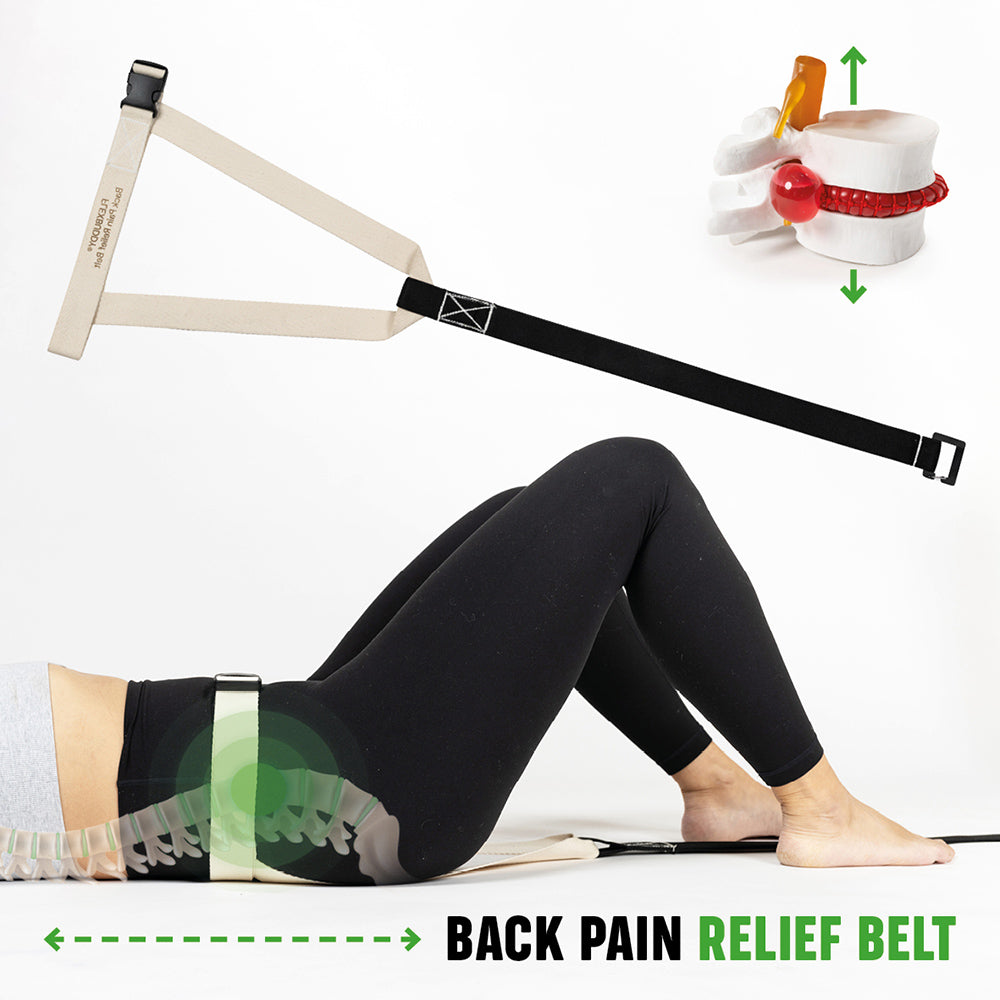
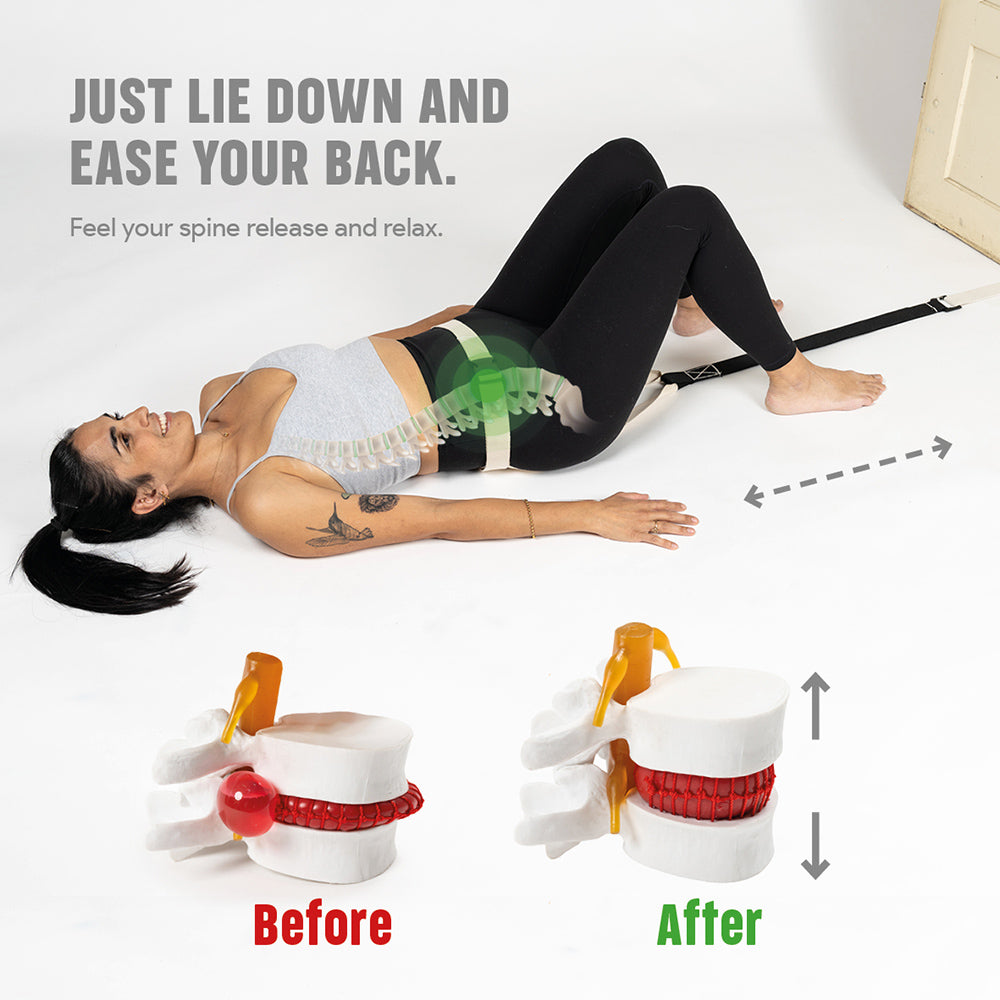
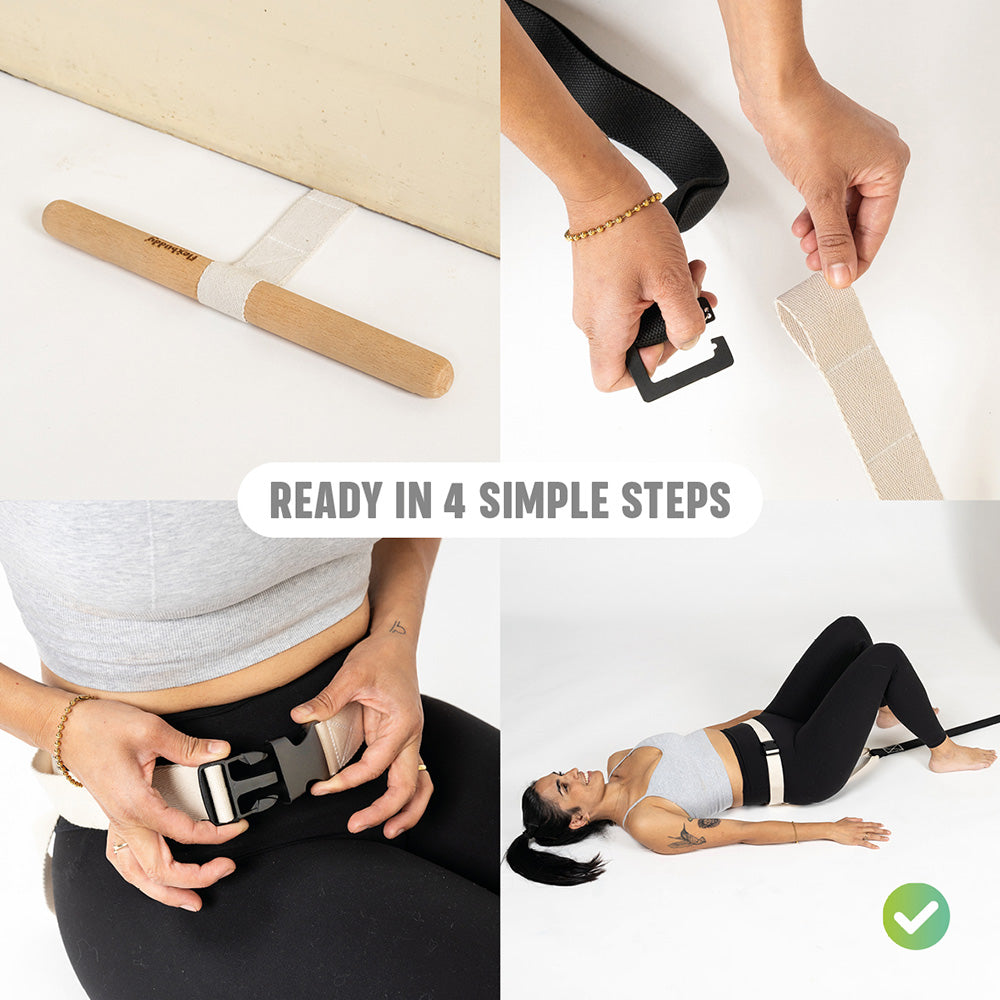
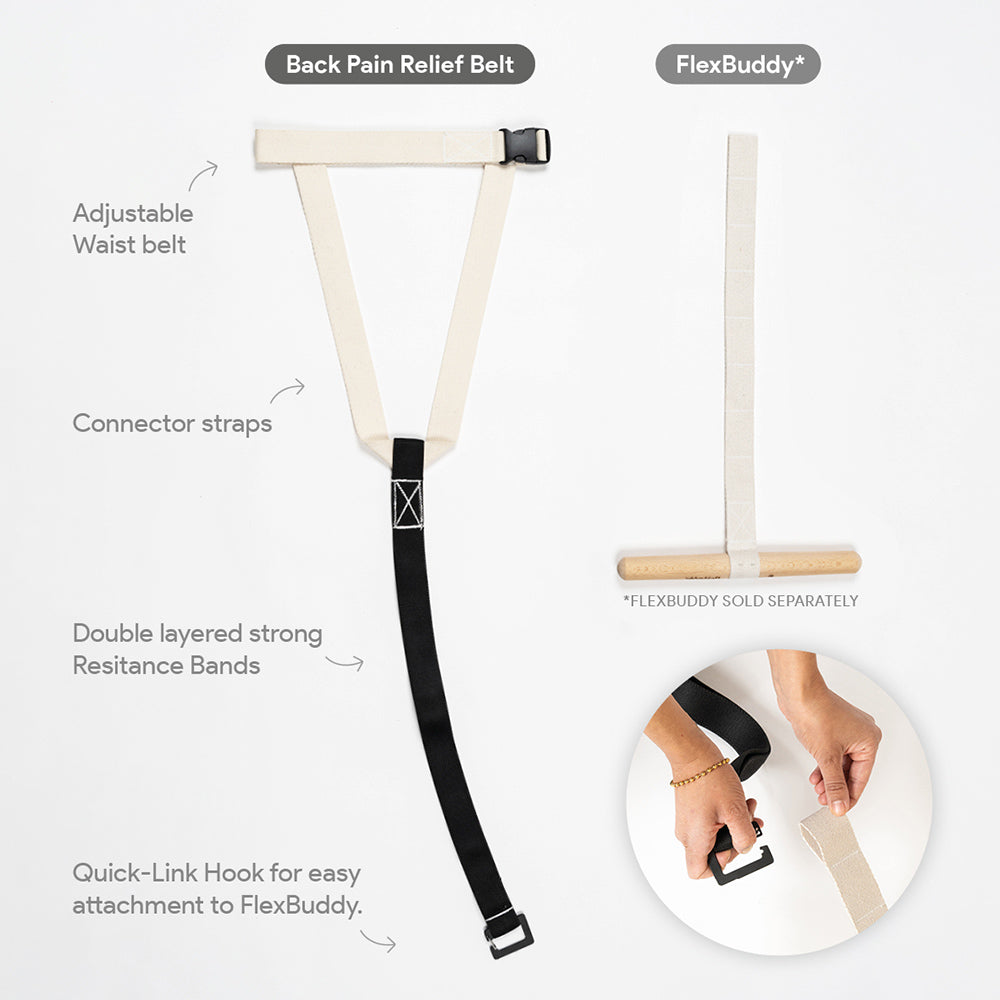
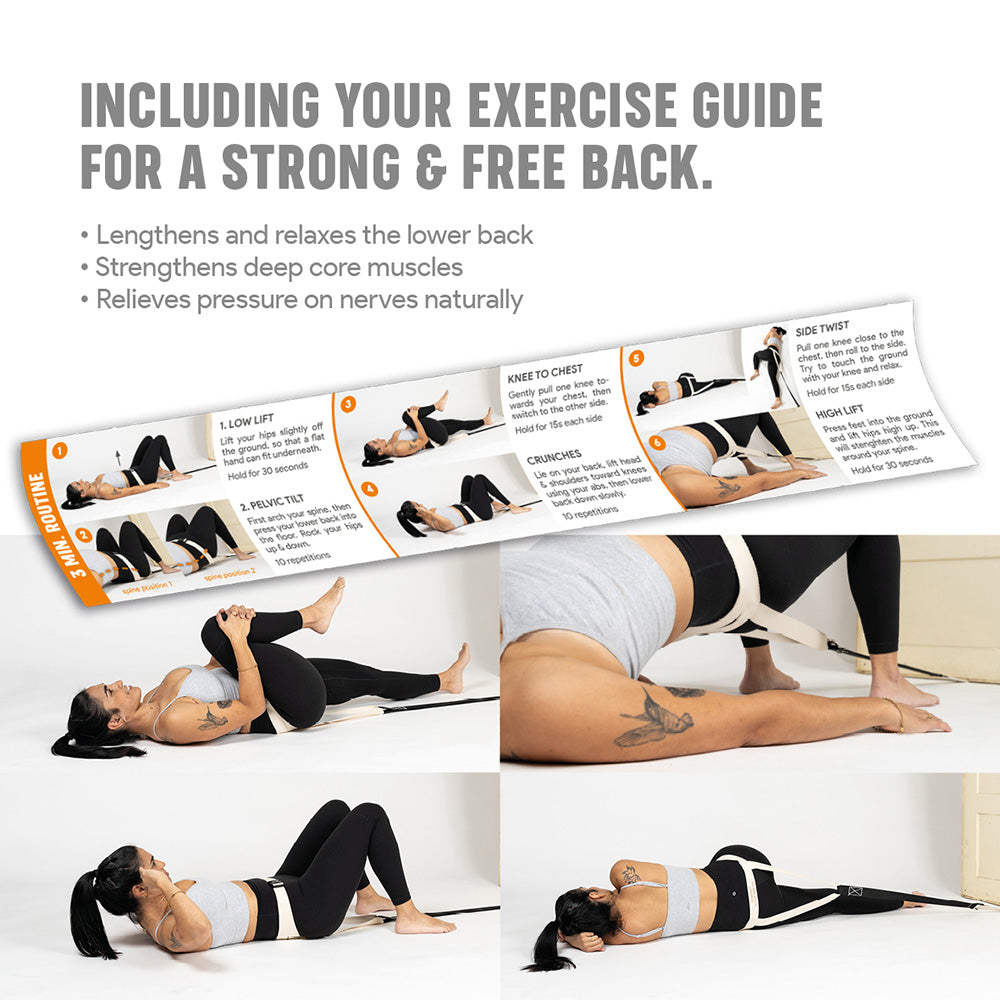
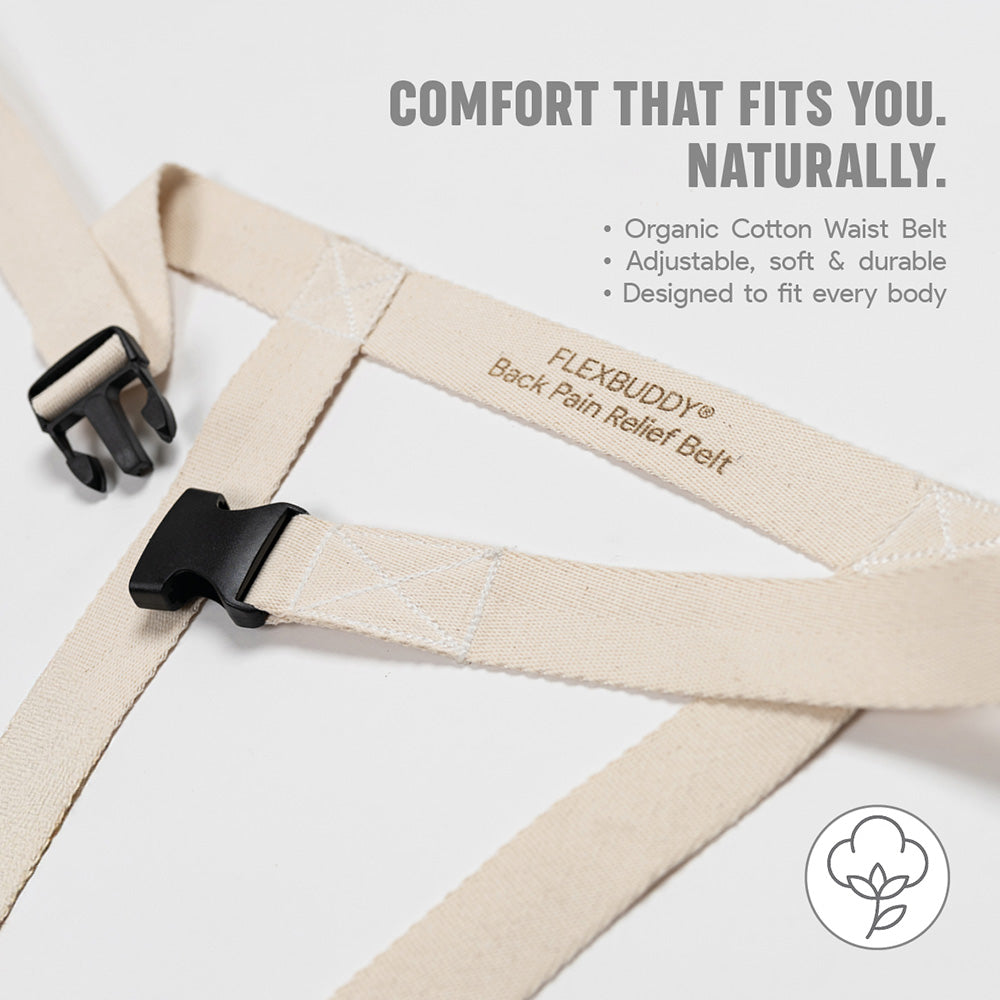
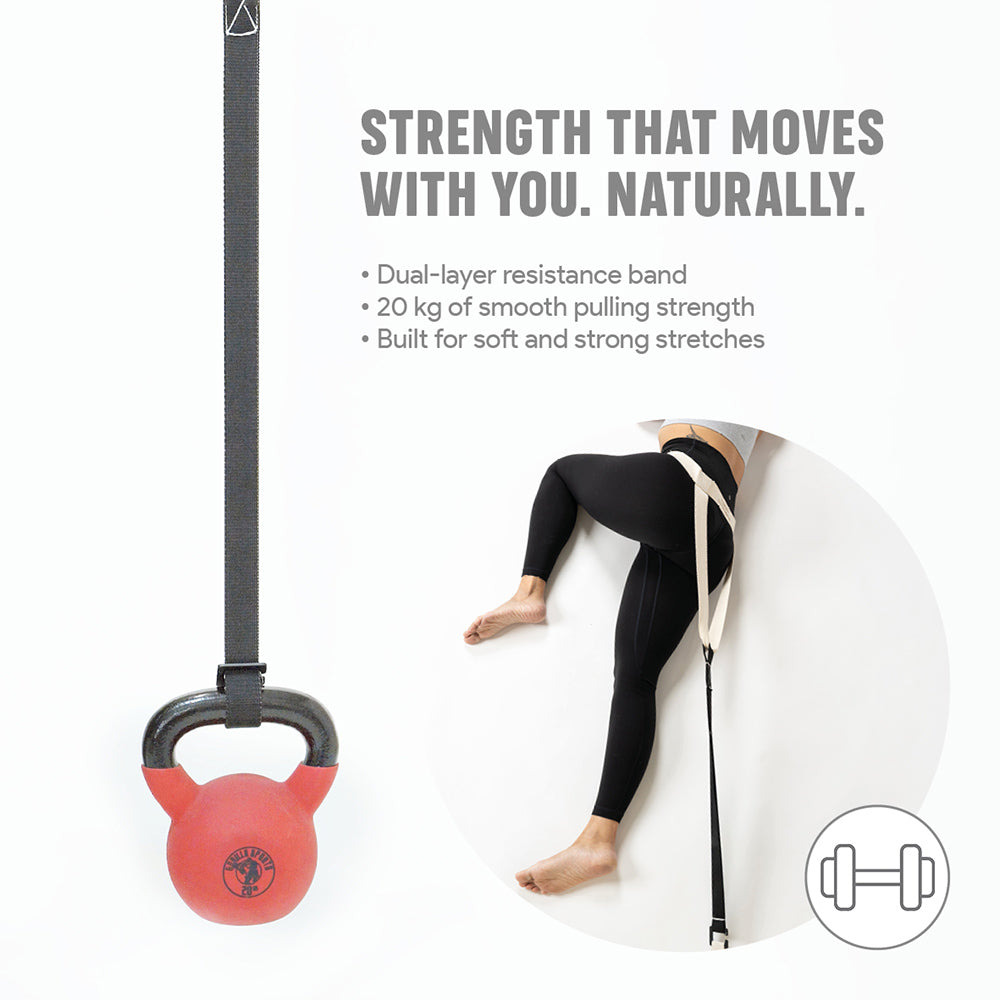
The dose is a 30-second hold, two or three times, at a position you can breathe in, with a straight back, most days. FlexBuddy® is a stretching device made of two beech-wood bars joined by an adjustable natural-cotton strap. One bar sits under the soles of your feet, the other in your hands; you sit tall, lean back and tilt the hips, and the strap carries the pull so your spine does not round to reach. The routine in its guide is the guideline in disguise: ten deep breaths in the static position, a 30-second pause, three rounds, about two minutes. Big changes of length come from moving the foot bar to another loop, small ones from rolling the strap round the hand bar, so a stiff beginner starts long and shortens a loop a week, and someone over 65 simply stays for a second set of ten breaths. The wooden handles do not cut into the hands the way a strap does. One owner, 64, wrote that he had never touched his toes and did so within a week. Lifetime warranty, 30-day money-back guarantee. See FlexBuddy or take the two-minute quiz.
Frequently asked questions
How long should you hold a stretch to increase flexibility?
Thirty seconds, repeated two or three times, on five or more days a week, for at least six weeks. In the trials that set the standard, 30 seconds gained as much range as 60, and once a day gained as much as three times a day [3][4]. Total weekly time and number of days matter more than the length of any single hold [5].
How long should you hold a stretch after a workout?
Ten to 30 seconds, two to four times per muscle, to mild tension [2][10]. The muscles are warm, so the holds feel easier and you can go closer to the end of range safely. Do not expect it to prevent next-day soreness; the trials say it does not [8].
How long do you need to hold a stretch for it to be effective?
Long enough to reach about 60 seconds per muscle in total within a session, in holds of 10 to 30 seconds [1][2]. In the trial that set the standard, single 15-second holds did not separate from no stretching, while 30-second holds did [3]. If you are over 65, aim for 30 to 60 seconds per hold [9][10].
Is 10 seconds enough to hold a stretch?
Not on its own, if your goal is flexibility. The lowest dose shown to work in adults is 30 seconds in one hold, or shorter holds repeated to a similar total [2][3]. Ten seconds is still useful as a movement break at a desk, and a few 10-second holds in a warm-up will not hurt performance [6].
Can you stretch too long?
You can stretch longer than is useful. Beyond 30 seconds per hold in younger adults the extra time adds nothing measurable [3][4], and a minute or more of static stretching per muscle immediately before sport reduces strength and power for a while afterwards [6][7]. A stretch that hurts, tingles or makes you hold your breath is too long or too deep regardless of the clock.
How often should you stretch to improve flexibility?
At least two to three days a week is the guideline floor, and daily is best [1][2]. The review evidence favours five or more days a week with a weekly total of five minutes or more [5]. Two minutes a day, most days, satisfies all of those.
This article is general information, not medical advice. Tight muscles usually respond well to regular stretching. If your pain is sharp, radiates down a leg, comes with numbness, weakness, fever, bladder or bowel changes, follows an injury, or keeps getting worse, see a doctor or physiotherapist before you stretch.
References
- Garber CE, Blissmer B, Deschenes MR, et al.; American College of Sports Medicine. Position stand: quantity and quality of exercise for developing and maintaining cardiorespiratory, musculoskeletal, and neuromotor fitness in apparently healthy adults. Med Sci Sports Exerc. 2011;43(7):1334–1359. doi:10.1249/MSS.0b013e318213fefb. PMID 21694556.
- Harvard Health Publishing. The ideal stretching routine. Harvard Medical School, 16 Mar 2026 (reviewed by H. E. LeWine, MD). https://www.health.harvard.edu/staying-healthy/the-ideal-stretching-routine (accessed 4 Nov 2026).
- Bandy WD, Irion JM. The effect of time on static stretch on the flexibility of the hamstring muscles. Phys Ther. 1994;74(9):845–850. doi:10.1093/ptj/74.9.845. PMID 8066111.
- Bandy WD, Irion JM, Briggler M. The effect of time and frequency of static stretching on flexibility of the hamstring muscles. Phys Ther. 1997;77(10):1090–1096. doi:10.1093/ptj/77.10.1090. PMID 9327823.
- Thomas E, Bianco A, Paoli A, Palma A. The relation between stretching typology and stretching duration: the effects on range of motion. Int J Sports Med. 2018;39(4):243–254. doi:10.1055/s-0044-101146. PMID 29506306.
- Behm DG, Blazevich AJ, Kay AD, McHugh M. Acute effects of muscle stretching on physical performance, range of motion, and injury incidence in healthy active individuals: a systematic review. Appl Physiol Nutr Metab. 2016;41(1):1–11. doi:10.1139/apnm-2015-0235. PMID 26642915.
- Simic L, Sarabon N, Markovic G. Does pre-exercise static stretching inhibit maximal muscular performance? A meta-analytical review. Scand J Med Sci Sports. 2013;23(2):131–148. doi:10.1111/j.1600-0838.2012.01444.x. PMID 22316148.
- Herbert RD, de Noronha M, Kamper SJ. Stretching to prevent or reduce muscle soreness after exercise. Cochrane Database Syst Rev. 2011;(7):CD004577. doi:10.1002/14651858.CD004577.pub3. PMID 21735398.
- Feland JB, Myrer JW, Schulthies SS, Fellingham GW, Measom GW. The effect of duration of stretching of the hamstring muscle group for increasing range of motion in people aged 65 years or older. Phys Ther. 2001;81(5):1110–1117. PMID 11319936.
- Page P. Current concepts in muscle stretching for exercise and rehabilitation. Int J Sports Phys Ther. 2012;7(1):109–119. PMC3273886. https://pmc.ncbi.nlm.nih.gov/articles/PMC3273886/ (accessed 4 Nov 2026).
- Harvard Health Publishing. Stretching: the new mobility protection. Harvard Medical School, 8 Nov 2016 (archived). https://www.health.harvard.edu/staying-healthy/stretching-the-new-mobility-protection (accessed 4 Nov 2026).
- Weppler CH, Magnusson SP. Increasing muscle extensibility: a matter of increasing length or modifying sensation? Phys Ther. 2010;90(3):438–449. doi:10.2522/ptj.20090012. PMID 20075147.
- Freitas SR, Mendes B, Le Sant G, Andrade RJ, Nordez A, Milanovic Z. Can chronic stretching change the muscle-tendon mechanical properties? A review. Scand J Med Sci Sports. 2018;28(3):794–806. doi:10.1111/sms.12957. PMID 28801950.
- Nakamura M, Ikezoe T, Umegaki H, Kobayashi T, Nishishita S, Ichihashi N. Changes in passive properties of the gastrocnemius muscle-tendon unit during a 4-week routine static-stretching program. J Sport Rehabil. 2017;26(4):263–268. doi:10.1123/jsr.2015-0198. PMID 27632863.
- Nakamura M, Yahata K, Sato S, et al. Training and detraining effects following a static stretching program on medial gastrocnemius passive properties. Front Physiol. 2021;12:656579. doi:10.3389/fphys.2021.656579. PMID 33868026; PMC8049289.
- Konrad A, Alizadeh S, Daneshjoo A, et al. Chronic effects of stretching on range of motion with consideration of potential moderating variables: a systematic review with meta-analysis. J Sport Health Sci. 2024;13(2):186–194. doi:10.1016/j.jshs.2023.06.002. PMID 37301370; PMC10980866.